

The snowball kiss meaning has become a trending search term due to its frequent appearance on platforms like TikTok, Instagram, and other social media discussions. Many users come across the phrase in comments or slang conversations and want a clear, simple explanation.
In this guide, you’ll learn what the term means, why it is trending online, and how it is used in modern slang—explained in a safe, easy-to-understand way.
What Is a Snowball Kiss?
A snowball kiss is an internet slang term that refers to a consensual adult interaction described in informal conversations or online slang communities.
It is not a formal dictionary phrase, and its meaning is mostly understood through social media usage rather than academic or official definitions.
People usually discover it through:
- TikTok videos and comments
- Online slang discussions
- Urban dictionary–style explanations
- Curiosity-driven searches
Because it is slang, the meaning can vary slightly depending on context, but it is generally used in adult-only conversations.
Snowball Kiss Meaning in Slang (Simple Explanation)
In slang usage, the snowball kiss meaning is connected to adult relationship terminology used in informal online communication.
It falls into the category of modern internet slang where users replace direct descriptions with coded or playful language. This is common in online spaces where people discuss sensitive topics indirectly.
Similar examples of slang behavior include:
- Using abbreviations instead of full phrases
- Using emojis or hints instead of direct wording
- Talking in coded language on social media platforms
Why Is “Snowball Kiss” Trending on TikTok?
Searches like “snowball kiss TikTok meaning” became popular because TikTok often spreads slang quickly without full explanations.
Here’s why the term gained attention:
- Users mention it without explaining it directly
- It appears in jokes, captions, or comment threads
- People search it out of curiosity after seeing it online
- TikTok trends often amplify mysterious or coded slang
Because of this, many users end up searching the meaning to understand the context behind the phrase.
Origins & History of the Term
Every word has a birthplace, even if that birthplace is murky.
The term snowball kiss does not trace back to a single dictionary entry or a famous literary work. Instead, like many colloquial expressions, it evolved organically across subcultures, picking up different meanings along the way.
In its most literal and innocent interpretation, a snowball kiss refers to a playful wintertime gesture — pressing a cold, snow-dusted cheek or a snowball-chilled kiss to someone’s lips or face. Think childhood winters, rosy cheeks, and laughter. This sweet, tactile expression of affection was well-documented in folk traditions across Northern Europe and North America as a seasonal gesture shared between friends or romantic partners.
Linguists note that compound nouns combining nature with physical affection — like butterfly kiss, Eskimo kiss, or angel kiss — have been part of the English lexicon for centuries. The snowball kiss fits naturally into this tradition. Dr. Anne Curzan, a professor of linguistics at the University of Michigan, has written extensively about how affectionate gestures acquire names through cultural repetition rather than deliberate coinage.
The pattern is consistent: someone does something endearing, someone else names it, and gradually the name sticks.
However, the term picked up an alternate, more adult connotation over time — particularly through its use in explicit media and online adult communities. This secondary meaning, rooted in a specific intimate act, is now often what people encounter first when they search the term online. The contrast between the innocent and the explicit is precisely what makes the term so frequently misunderstood.
How Snowball Kiss Spreads Online
The internet is history’s most efficient rumor mill — and one of its most effective vocabulary tutors.
Snowball kiss spread across digital spaces through a combination of forums, social platforms, streaming content, and search behavior. Reddit communities devoted to language, relationships, and adult content each played a role in amplifying the term to different audiences simultaneously. Meanwhile, YouTube reaction videos and TikTok “did you know” content helped bring it into mainstream awareness — often without providing much context.
Search data tells a compelling story. According to trends in keyword behavior, searches for “snowball kiss meaning” spike regularly among users aged 18 to 34 — the demographic most likely to encounter niche terminology through social platforms and then immediately turn to search engines for clarity.
The term behaves similarly to other “curiosity-driven” search queries: people hear it, feel slightly lost, and quietly look it up.
This kind of organic, search-led discovery is a hallmark of how taboo-adjacent language spreads. It rarely announces itself loudly. It seeps in through context — a line in a podcast, a passing joke in a comment section — and then curiosity does the rest.
Common Misconceptions About Snowball Kiss
Misunderstandings about snowball kiss are almost a genre unto themselves.
The most common misconception is that the term has one universally agreed-upon meaning. It does not. Depending on who you ask — and in what context — snowball kiss might evoke a cheerful winter memory, an intimate act between adults, or even a metaphorical expression used in casual conversation to describe something cold and unexpected.
A second misconception is that the term is inherently offensive or vulgar. While one of its meanings is explicit and therefore inappropriate in many settings, the term itself is context-dependent. Saying “he gave her a snowball kiss on New Year’s Eve” in a family story is not the same as using the term in an adult context online. Language, as always, derives meaning from context — not from the words alone.
A third and surprisingly persistent myth is that snowball kiss originated as internet slang. As explored in the origins section, its innocent usage pre-dates the internet by decades. The web did not create it; it merely amplified and bifurcated it.
Finally, many people assume that awareness of the explicit meaning obligates them to treat every mention of the term as inappropriate. This is, frankly, linguistic anxiety at work — the fear that knowing a word’s darker meaning somehow contaminates all its other meanings.
Linguists and communication experts consistently push back on this idea. Words carry multiple meanings all the time. The speaker’s intent and the surrounding context are what matter most.
How to Respond When Someone Mentions It
Picture this: you are at a casual gathering, and someone laughs and says, “That was such a snowball kiss moment.” You have no idea what they mean, and the laughter around you suggests you probably should.
The graceful response? Simply ask.
Responding to unfamiliar slang with genuine curiosity is almost always socially safe. A calm “I haven’t heard that one — what do you mean?” signals confidence, not ignorance. It also opens up a conversation rather than shutting one down.
If the context is clearly innocent — a winter story, a children’s anecdote, a lighthearted moment — engage with it as such. If the context feels ambiguous and you are in a professional or formal setting, a polite redirect is perfectly appropriate.
Something like “That one’s new to me — maybe explain later?” works well without creating awkwardness.
Communication experts often emphasize that the discomfort people feel around misunderstood slang comes not from the words themselves but from the fear of appearing uninformed. The antidote is simple: intellectual honesty. Nobody knows every term. Asking is not weakness — it is intelligence in action.
Cultural and Regional Perspectives
Language does not exist in a vacuum, and snowball kiss is no exception.
In Scandinavian cultures, where winter is long and physical affection between friends is expressed more freely than in many other parts of the world, the idea of cold-weather kisses carries a warmth that transcends temperature. The snowball kiss, in its innocent form, fits naturally into this cultural fabric.
In North American popular culture, particularly in the United States and Canada, the term occupies a more complicated space. The puritanical streak in American cultural history means that any term straddling the line between innocent and explicit tends to generate anxiety.
This explains why online discussions about snowball kiss in American forums often default immediately to the explicit definition, even when the original context is innocent.
In the United Kingdom and Australia, internet slang tends to spread more slowly through traditional social channels, meaning that many speakers in these regions may encounter the innocent usage far more frequently than the explicit one — the opposite of what American internet users often experience.
Understanding these regional differences is not just an academic exercise. It has real implications for how we communicate across cultures. A term that raises eyebrows in one country may be entirely unremarkable in another.
Comparing Snowball Kiss with Other Gestures
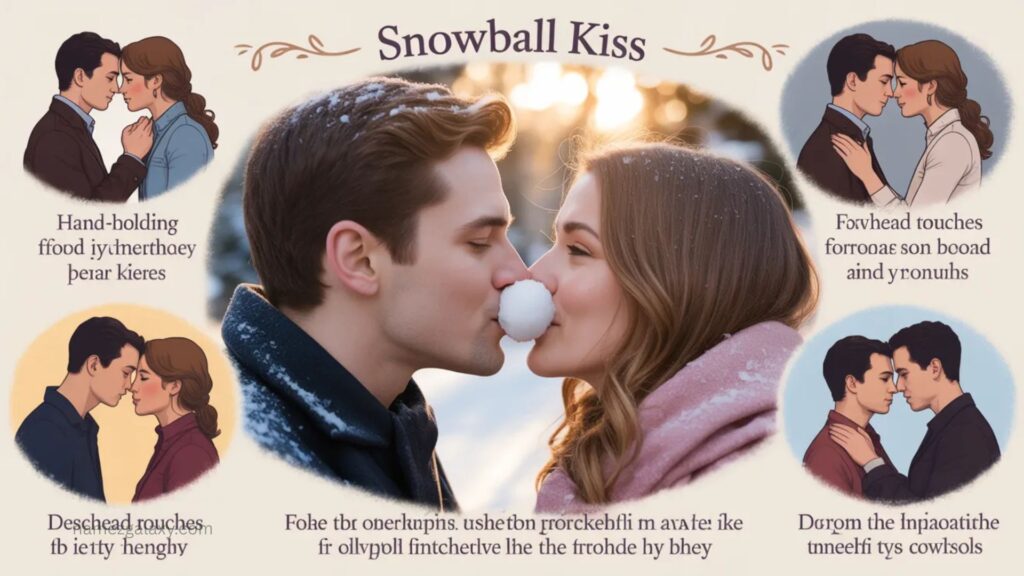
Context becomes clearer when snowball kiss is placed alongside similar terms.
Consider the butterfly kiss — the gentle fluttering of eyelashes against someone’s cheek. It is widely understood as innocent, tender, and childlike. Or the Eskimo kiss, now more commonly called a nose kiss or kunik (its proper Inuit name), which involves pressing noses together.
Then there is the angel kiss, a term used to describe both a tender forehead kiss and a birthmark.
All of these terms share a structural similarity: a noun from nature or innocence combined with the word “kiss.” All of them carry connotations of gentleness and affection. And all of them, in one internet corner or another, have been co-opted or recontextualized.
What separates snowball kiss from most of these is the degree to which its explicit alternate meaning has outpaced its innocent one in online visibility. Google’s search algorithms, driven by user behavior, tend to surface the most-clicked results — and in the case of snowball kiss, those results skew adult.
This creates a feedback loop: more people find the explicit meaning first, reinforcing its dominance in search results, even though the innocent usage remains linguistically and historically valid.
This is a fascinating case study in how digital platforms shape linguistic perception at scale.
Filling the Gaps: Linguistic Evolution & Psychology of Curiosity
Why do people feel so compelled to look up terms like snowball kiss?
The answer lies at the intersection of linguistics and psychology. Humans are pattern-recognition machines. When we encounter a word we do not fully understand — especially one that seems to carry social weight — our brain flags it as a gap. Gaps are uncomfortable. We fill them.
Psychologists refer to this as the information gap theory of curiosity, first articulated by George Loewenstein of Carnegie Mellon University. The theory suggests that curiosity is triggered not by a desire to know everything, but by the awareness of a specific thing we do not know. The moment you hear “snowball kiss” in a context that suggests shared knowledge, the gap opens. Closing it becomes almost irresistible.
Linguistically, the evolution of snowball kiss mirrors a well-documented process called semantic broadening and narrowing. A term begins with a clear, specific meaning, then broadens to include metaphorical or alternate uses, and may eventually narrow again as one meaning dominates cultural usage.
English is full of examples: “awful” once meant “inspiring awe,” “silly” once meant “blessed,” and “nice” once meant “foolish.” Language is never static.
Snowball kiss is, in this sense, a perfectly ordinary word doing perfectly ordinary things — it just happens to be doing them in the very public, very accelerated environment of the internet.
Suitability for Professional Communication
Let us be direct: snowball kiss is not appropriate for professional communication — at least, not without careful qualification.
This is not about prudishness. It is about precision. Professional environments depend on shared, unambiguous language. Terms with dual meanings — one innocent, one explicit — introduce unnecessary risk of misunderstanding, discomfort, or perceived impropriety.
The potential upside of using such a term at work is minimal. The potential downside is not.
This principle extends beyond snowball kiss to any slang that has developed explicit connotations. Human resources professionals and workplace communication coaches consistently advise erring on the side of clarity. If a term requires explanation or qualification to avoid misinterpretation, it is generally better to choose a different term altogether.
In educational settings, the calculus is slightly different. Teachers, curriculum designers, and media literacy educators may find genuine value in discussing how terms like snowball kiss evolve, spread, and bifurcate in meaning — as a window into linguistics, digital culture, and critical thinking. In that framing, the term becomes a teaching tool rather than a liability.
The key, as always, is intentionality. Know your audience. Know your purpose. And when in doubt, choose the clearer word.
Is the Snowball Kiss a Safe or Appropriate Topic?
The term itself is part of adult slang, so it is generally used in mature or private discussions rather than formal settings.
It’s important to understand:
- It is not suitable for children or educational contexts
- It appears mostly in informal online conversations
- Meaning depends heavily on context and intent
If you encounter the phrase online, it is usually part of casual slang rather than something literal or medical.
Key Takeaway
The snowball kiss meaning is an example of modern internet slang that became popular through TikTok and social media. While the phrase may sound confusing at first, it simply reflects how online communities often use coded language to discuss adult topics indirectly.
Snowball Kiss vs Rainbow Kiss: What’s the Difference?
A very common search query is “snowball kiss vs rainbow kiss meaning”, because people often see both terms together online.
Here’s the simple breakdown:
- Snowball kiss → Slang term used in adult intimacy discussions
- Rainbow kiss → Another separate slang term, also adult-only in nature
Although both belong to internet slang related to intimacy, they are not the same concept. They are often grouped together online simply because people search for unusual or trending slang phrases at the same time.
Is Snowball Kiss Sexual?
Yes, in general usage, snowball kiss is considered sexual slang.
That means:
- It is intended for adult audiences only
- It is not appropriate for children or educational school content
- It appears in informal or private conversations
- It should always be understood in a consensual adult context
Responsible explanations focus on meaning and awareness rather than explicit detail, because context and sensitivity matter when discussing intimate slang.
Is Snowball Kissing Safe? What You Should Know
The “safety” of any intimate activity—whether discussed online or in real life—depends on personal and mutual factors.
Key points include:
- Consent must always be clear and mutual
- Personal boundaries should be respected at all times
- Health awareness is important in any intimate situation
- Both partners should fully understand and agree before anything happens
If you are unsure about a slang term or what it implies, the safest approach is exactly what you’re doing—learning the meaning first before making assumptions.
Snowball Kiss in Relationship Contexts
In real-world or online relationship discussions, the term may appear in:
- Private conversations between adults
- Slang-based jokes or internet humor
- Online forums discussing intimacy or dating culture
However, it is important to note:
- It should never involve pressure or expectation
- Both people must clearly understand the meaning
- Consent and communication always come first
Healthy relationships prioritize clarity, respect, and mutual comfort over internet trends or slang terms.
Why People Search “Snowball Kissing Meaning”
This keyword is trending because:
- People encounter the term on TikTok or social media
- It is often mentioned without explanation
- Users become curious about its meaning
- It is part of viral internet slang culture
As with many modern slang terms, meaning spreads faster than explanation, which leads to more searches.
Are There Any Non-Intimate Meanings of Snowball Kiss?

Based on general language use, there is no established mainstream definition of “snowball kiss” outside of slang contexts.
When the phrase appears outside of adult-related discussions, it is usually:
- A misunderstanding of slang terms
- A joke used online without a real definition
- A made-up phrase used for humor or shock value
- A metaphor with no consistent or recognized meaning
In other words, it does not function as a standard expression in everyday communication.
Why People Think It Has Other Meanings
Many users assume the term might have a different meaning because of how it sounds. Words like “snowball” often relate to innocent ideas such as winter, snow, or playful activities.
However, online slang often combines normal-sounding words with completely different meanings. This creates confusion, especially when:
- The phrase is seen without context
- It appears in TikTok comments or memes
- It is shared without explanation
- People encounter it for the first time in viral content
This is why searches like “snowball kiss meaning explained” or “alternate meaning of snowball kiss” have become common.
Context Matters: How “Snowball Kiss” Is Usually Used
In most online cases, the term is:
- Used as slang in adult conversations
- Shared indirectly in social media discussions
- Mentioned as part of internet curiosity or trends
Outside of this context, it is rarely used in any meaningful or formal way. That is why it does not appear in standard dictionaries or professional language references.
Important Clarity Most Sources Miss
One key point that many explanations overlook is this:
👉 There is no widely recognized alternative definition of “snowball kiss” in formal English usage.
So if you see it used differently, it is almost always:
- Internet slang being misunderstood
- A playful or sarcastic reference
- A context-specific joke rather than a real definition
This is important for avoiding confusion and misinterpretation online.
Real-World Example of Misuse
For example, someone might see the term in a TikTok comment thread and assume it refers to something related to winter or kissing in snow. In reality, it is usually:
- A coded slang reference
- A meme-related phrase
- Or part of an adult conversation using indirect language
This gap between appearance and meaning is what leads to so many searches
Frequently Asked Questions
What does snowball kiss mean?
The term has two distinct meanings. In its innocent form, a snowball kiss is a playful, cold-weather gesture involving pressing a chilled face or lips to someone else’s — a wintertime expression of affection. In its adult context, it refers to a specific intimate act. The meaning depends entirely on context.
Is snowball kiss a real dictionary word?
No, it is not found in formal dictionaries and is considered internet slang.
Why do people search snowball kiss meaning?
Because it appears on social media like TikTok without explanation, making people curious.
Is snowball kiss a safe term to search?
Yes, it is generally safe for informational purposes, but it refers to adult slang.
Does snowball kiss have a normal meaning?
No widely accepted normal or everyday meaning exists for this phrase.
Is snowball kiss related to romance?
It appears in discussions about intimacy, but it is not a standard romantic term.
Where is the term snowball kiss used?
It is mostly seen on social media platforms, slang websites, and online discussions.
Is snowball kiss appropriate for kids?
No, it is considered adult slang and not suitable for children.
Is snowball kiss the same as a regular kiss?
No, it is a slang expression and not related to a normal kiss.
Why is snowball kiss trending online?
It trends because people see it in memes or comments and search its meaning out of curiosity.
Where did the term snowball kiss originate?
The innocent version of snowball kiss traces back to folk traditions in cold-weather regions, particularly Northern Europe and North America, where winter gestures of affection were common and culturally celebrated. The explicit meaning emerged later through its use in adult media and online communities.
Is snowball kiss appropriate to use in conversation?
It depends on your audience and context. In casual, informal settings among people who share the same understanding of the term, it may be perfectly fine. In professional, formal, or mixed-audience settings, it is best avoided due to the risk of misinterpretation.
Why do people search for snowball kiss online?
Most searches are curiosity-driven — people encounter the term without context and turn to search engines for clarity. This follows the information gap theory of curiosity, which holds that humans are compelled to close knowledge gaps once they become aware of them.
Is snowball kiss only an English-language term?
Primarily, yes. The term is most widely recognized in English-speaking countries and in English-language online spaces. Equivalent concepts exist in other cultures but may carry different names and connotations.
How has the internet changed the meaning of snowball kiss?
The internet amplified and bifurcated the term, simultaneously spreading both its innocent and explicit meanings to global audiences. Search algorithm behavior has further skewed online visibility toward the explicit definition, even though the innocent meaning remains historically valid.
Conclusion
The snowball kiss meaning is mainly used in online slang and social media conversations. It is not a formal dictionary term and does not have a literal meaning in everyday language. People usually see it on platforms like TikTok or in internet comments, which leads them to search for its explanation. Understanding the context helps clear up confusion and shows how quickly slang spreads online.
Overall, this term is part of modern internet slang rather than standard communication. It is important to understand it only in an informational way and not take it literally. Most people search its meaning out of curiosity after seeing it online. Learning such terms helps you stay updated with how online language and trends evolve.

Robert Sam is a passionate name enthusiast and creative wordsmith dedicated to exploring the stories, meanings, and cultural depth behind names. As the lead writer at NamesGalaxy.com, he brings years of research and a love for language to help readers discover unique, memorable, and meaningful names for characters, babies, pets, brands, and more.
With a talent for blending creativity and clarity, Robert crafts insightful guides, name lists, and storytelling-rich explanations that make name-finding an enjoyable journey. Whether you’re building a fantasy world, creating a powerful persona, or searching for the perfect identity, Robert’s work is designed to inspire imagination and spark new ideas across every naming niche.