
Picture this: you’re scrolling through your phone, and a friend sends you a message that simply says, “WYF?” You stare at it for a moment, unsure whether to reply confidently or quietly Google it before responding. Sound familiar? You’re not alone.
Texting and social media have given birth to a whole new language — one built on abbreviations, acronyms, and shorthand that evolve faster than most people can keep up. Among the most frequently searched of these digital shorthand phrases is WYF, a term that pops up regularly in text conversations, on Snapchat, Instagram DMs, and across various social media platforms.
Whether you’re a parent trying to decode your teenager’s messages, a young adult wanting to use internet slang correctly, or simply someone who stumbled across the abbreviation and needs answers, this article has you covered. We’re going to break down the WYF meaning in text from every angle — what it means, how it’s used, when you should (and shouldn’t) use it, and a few surprising alternate meanings you probably haven’t considered.
Let’s dive in.
What Does WYF Mean?
At its core, WYF stands for “Where You From?”
It’s a casual, conversational abbreviation used primarily in text messaging and online chat. When someone sends you “WYF,” they’re asking about your location, hometown, or place of origin. The phrase is informal and is most commonly used among peers, especially in younger demographics between the ages of 13 and 30.
Think of it as the digital equivalent of walking up to someone at a party and asking, “So, where are you from?” It’s a social icebreaker — quick, friendly, and low-effort.
The abbreviation follows the classic formula of internet slang: take a common phrase, strip it down to its first letters, and fire it off in a message before someone even finishes typing “Hello.” In the age of instant communication, brevity is currency.
WYF Meaning in Text
When you see WYF in a text message, it almost always means “Where You From?” It’s used to start a conversation, get to know someone better, or express curiosity about a person’s background or geographic location.
Text messaging culture thrives on speed. Nobody wants to type out a full sentence when three letters will do the job. The WYF abbreviation is a perfect example of how texting has compressed language into its most essential form.
It’s worth noting that WYF is more commonly used in casual, informal conversations. You wouldn’t typically see it in professional emails or formal communication — it belongs firmly in the world of personal messaging, group chats, and social media.
Example:
Alex: Hey! Just saw your profile. WYF?
Jordan: I’m from Chicago! What about you?
Alex: No way, I’m from Milwaukee! We’re practically neighbors lol
In this example, WYF serves as a natural conversation starter. It invites the other person to share something personal without being intrusive.
What Does WYF Mean in a Text?
When someone texts you WYF, the most likely interpretation is “Where You From?” — a simple question about your hometown or current location. It’s often used when two people are just getting to know each other, whether through a dating app, social media platform, or a mutual friend’s introduction.
The tone is almost always friendly and curious. It doesn’t carry any negative connotation and is rarely used sarcastically. If anything, it signals that the person on the other end is interested in connecting.
That said, context still matters. If the conversation has been going on for a while and suddenly someone drops a “WYF,” it could also be a way of double-checking where you’re located before making plans to meet up.
What Does WYF Mean on Snap?
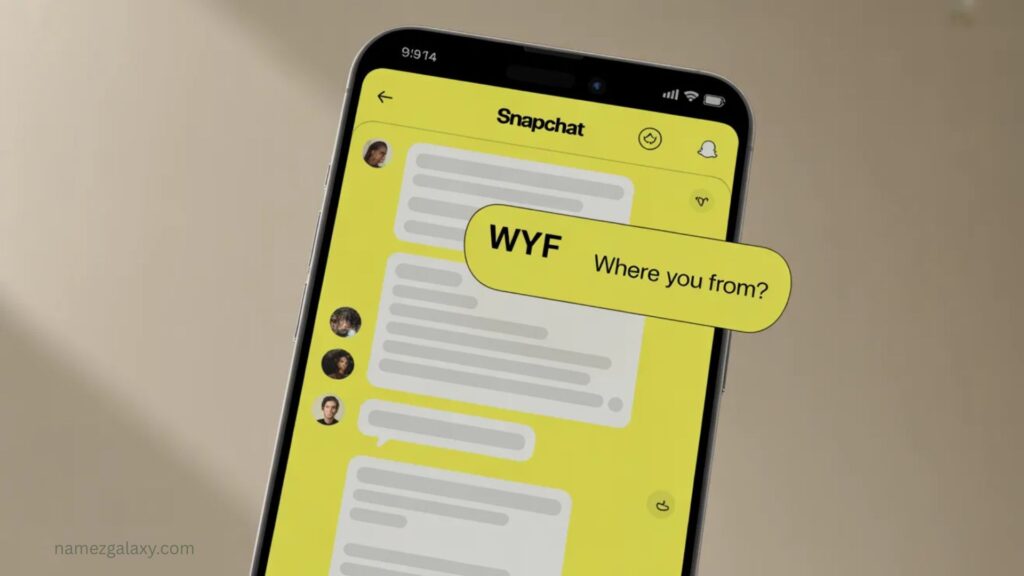
Snapchat has its own culture, its own unspoken rules, and — naturally — its own way of using slang. On Snap, WYF carries the same primary meaning: “Where You From?”
Snapchat users, many of whom are teenagers and young adults, frequently use abbreviations to keep messages quick and casual. Because Snapchat conversations are often fleeting (messages disappear, after all), getting to the point fast is part of the platform’s DNA. WYF fits perfectly into that environment.
It’s also common on Snapchat to see WYF used in the early stages of a conversation — often right after someone adds a new contact or starts chatting with someone they met through a Snap map, mutual friend, or public story.
WYF Meaning Snapchat Example:
[New Snap Message]
Tyler: Yo, just added you from the group chat. WYF?
Maya: I’m in Atlanta! You?
Tyler: Dallas here 👋
Notice how the exchange is brief, breezy, and gets straight to the point — which is exactly the kind of energy Snapchat is known for.
WYF Meaning in Text Snapchat
Whether you’re on Snapchat or receiving a regular SMS text, the WYF meaning remains consistent: “Where You From?”
The platform doesn’t change the meaning, but it might change how frequently you encounter it. Snapchat, Instagram DMs, TikTok comments, and similar platforms tend to have higher concentrations of slang usage compared to traditional texting — simply because those platforms attract younger, more digitally fluent audiences.
According to a 2023 survey by the Pew Research Center, over 95% of teenagers in the United States own or have access to a smartphone, and the vast majority communicate primarily through messaging apps. This digital-first generation has developed its own vocabulary, and WYF is one of its staple expressions.
What Does WYF Mean?
Let’s reinforce this for clarity. WYF = “Where You From?”
It’s used to ask about someone’s geographic origin, hometown, city, state, or country. The question can be both literal (asking about where you physically live right now) and more broadly biographical (asking where you grew up or where you consider home).
How to Respond to WYF (Text Meaning & Best Replies)
The meaning of WYF depends on the conversation, so the right reply changes with context. Understanding the intent helps you respond naturally and keep the chat flowing smoothly.
When WYF Means “Where You From”
In casual chats, WYF often asks about your location or hometown. Keep your answer simple and friendly, then return the question to keep the conversation going.
Example:
“Hey! WYF?” → “I’m from Chicago. What about you?”
When WYF Means “What You Fancy”
Sometimes WYF is used to ask what you want or prefer, especially when making plans like food, movies, or activities. Reply with your choice clearly and casually.
Example:
“WYF for dinner tonight?” → “I’m thinking pizza. What do you feel like?”
When WYF Means Feedback Request
In work, gaming, or creative discussions, WYF can mean someone is asking for your opinion. Give honest, clear feedback so the conversation stays useful.
Example:
“WYF on this design?” → “It looks solid, but the font could be a bit bigger.”
Whats WYF Mean?
For anyone searching for a quick answer: WYF means “Where You From?” It’s one of the most straightforward abbreviations in modern texting slang, and unlike some acronyms that have evolved into multiple meanings, this one is fairly consistent across platforms and communities.
What Do WYF Mean in Text?
To put it plainly: if someone sends you WYF in a text, they want to know where you’re from. It’s a conversational opener and a way to learn more about who you’re talking to. It’s casual, friendly, and commonly used by teens, young adults, and anyone who’s comfortable with modern texting shorthand.
How to Use the WYF Meaning in Online Conversations?
Now that you know what WYF means, let’s talk about how to use it effectively. Like any slang term, WYF has a natural context and tone — using it incorrectly can make a conversation feel awkward or out of place.
Correct Usage Examples:
1. Starting a new conversation:
“Hey! WYF? I’m from Miami.”
This is the most natural use of WYF. It’s an open-ended question that invites the other person to share and creates space for a back-and-forth exchange.
2. Getting to know someone online:
“We’ve been chatting for a while but I never asked — WYF originally?”
This version adds a bit of warmth and acknowledges the existing connection before asking.
3. Making plans:
“WYF? Trying to see if we’re close enough to hang out sometime.”
Here, WYF has a practical purpose — scoping out geographic proximity before suggesting a meetup.
4. On social media:
[Replying to a comment] “WYF? Your slang sounds like you might be from the South lol”
This version is light-hearted and playful, using WYF as part of a friendly exchange.
When NOT to Use WYF:
Despite its charm, WYF isn’t appropriate in every context. Here are some situations where you should avoid it:
- Professional settings: Never use WYF in a work email, business message, or professional networking conversation. It reads as unprofessional and can undermine your credibility.
- Formal introductions: If you’re being introduced to someone in an official capacity — a professor, a potential employer, or a new colleague — stick to proper language.
- When talking to older adults who may not know the slang: This could lead to confusion or even offense if the abbreviation is misunderstood.
- In sensitive conversations: If someone has shared something emotional or difficult, responding with casual slang like WYF can come across as dismissive.
The golden rule? Match your language to your audience and the tone of the conversation.
WYF Meaning for Non-Native English Speakers 🌎
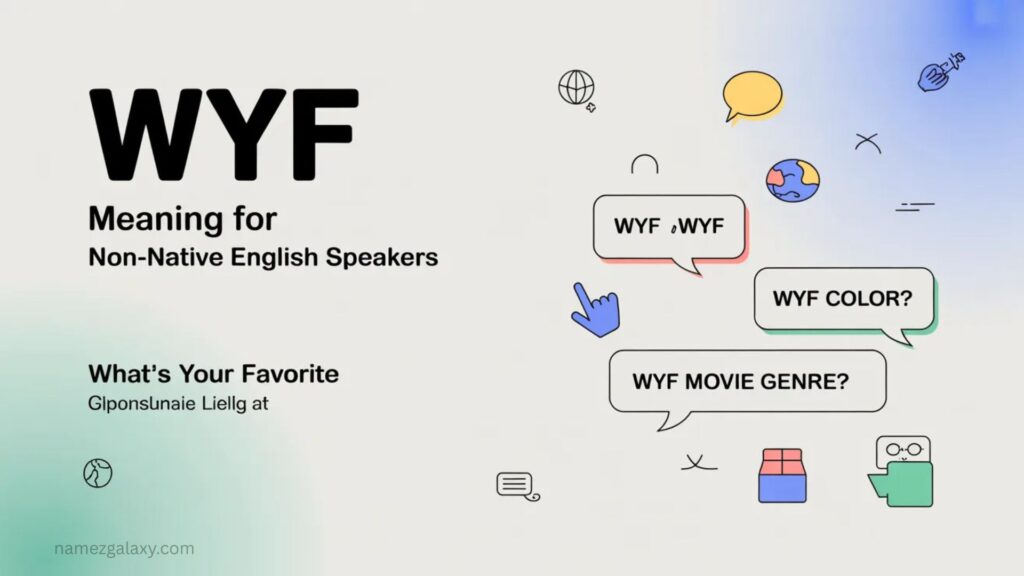
For English learners, WYF can feel confusing at first. In simple terms, it’s just a casual shortcut for asking “Where are you from?” in online chats.
Understanding slang like WYF helps you communicate more naturally and confidently in texting, social media, and messaging apps.
Psychology Behind Asking WYF 🧠
People use WYF in conversations for simple social reasons:
- Finding common ground 🤝
- Learning about someone’s culture 🌍
- Starting a friendly conversation 💬
It works as a natural icebreaker that helps people connect quickly.
How WYF Builds Connections 🌐
Asking WYF can lead to deeper and more meaningful conversations. Once you know someone’s background, it often opens topics like:
- Food and traditions 🍲
- Travel experiences ✈️
- Cultural differences 🌏
This makes WYF more than just a question—it becomes a way to build real connections.
WYF in Pop Culture 🎭

WYF is also common in online culture, including memes, captions, and comment sections. It reflects how modern communication is:
- Fast ⏩
- Casual 💬
- Short and expressive 📱
Examples of WYF in Sentences ✍️
- “WYF? Your accent sounds really cool.”
- “Someone added me and immediately asked WYF.”
- “He said WYF, so I told him my city.”
Is It Safe for Kids to Use WYF Meaning?
This is a question many parents find themselves asking as they try to keep up with their children’s digital vocabulary. The honest answer? It depends.
Safety Considerations:
The phrase itself — “Where You From?” — is harmless. However, the concern lies in context. When a child or teenager is asked WYF by a stranger online, it could be part of an attempt to gather personal information.
Digital safety experts consistently warn that sharing location information with strangers online — even something as seemingly benign as a hometown — can have real-world risks. Predators and bad actors often use casual conversation to build trust before asking increasingly personal questions.
A 2022 report from the Internet Watch Foundation found that online grooming often begins with seemingly innocent questions designed to establish connection and gather information — including location.
Recommendation:
If you’re a parent, it’s worth having an open conversation with your child about:
- Who they’re sharing location information with online
- Why strangers might ask WYF and what they could do with that information
- The difference between safe, known contacts and strangers online
The abbreviation isn’t inherently dangerous, but awareness of how it’s being used — and who’s asking — is essential.
Alternate Meanings of WYF Abbreviation
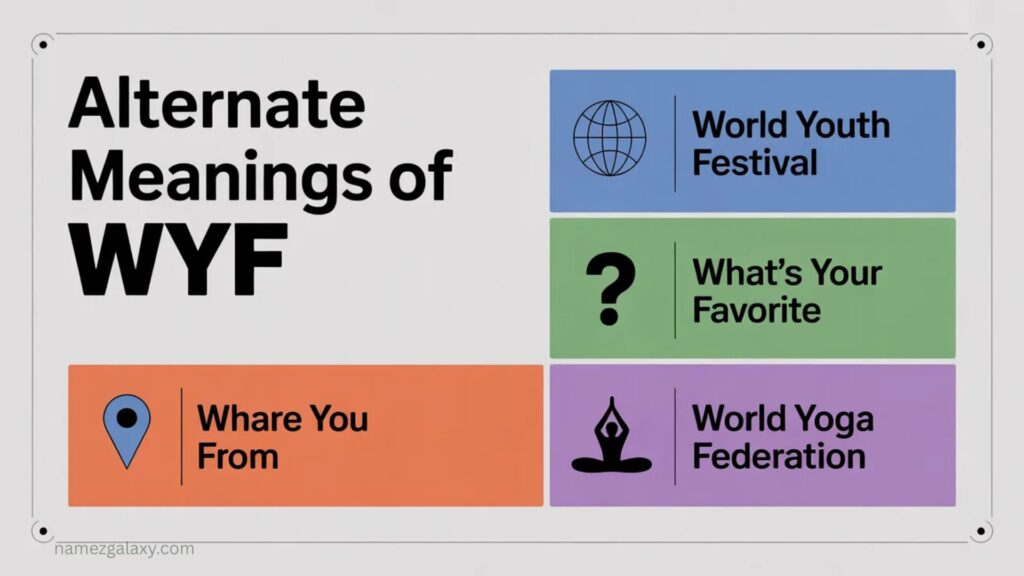
Language is rarely one-dimensional, and WYF is no exception. While “Where You From?” is by far the most common interpretation, there are a handful of alternate meanings floating around in different communities and platforms.
Possible Alternate Meanings:
1. “Watch Your Feelings” In some emotional or therapeutic online communities, WYF has been used as shorthand for “Watch Your Feelings” — a reminder to be mindful of your emotional state and reactions. This usage is niche and less common, but it exists.
2. “What’s Your Favorite?” In some casual quiz-style conversations or social media games, WYF can pop up as “What’s Your Favorite?” — as in, “WYF color?” or “WYF food?” This version is playful and is often used in icebreaker games within group chats.
3. “With Your Friends” Occasionally, WYF is used to mean “With Your Friends,” typically in the context of making plans: “Are you coming WYF or solo?” This usage is less standardized and more context-dependent.
4. “Work Your Flow” In hip-hop and creative communities, WYF sometimes appears as “Work Your Flow” — an encouragement to express yourself authentically. It’s a motivational phrase, but again, this interpretation is niche.
The takeaway? Always read the context before jumping to a single interpretation. In most cases, “Where You From?” will be the right answer — but it’s worth keeping the others in mind.
Is WYF Rude or Polite? 🧠
WYF is generally considered neutral and polite in most casual conversations. However, how it feels depends on tone and context.
It can come across as:
- Friendly in everyday texting 💬
- Flirty in dating chats 💕
- Too informal in professional or work settings ⚠️
Important Tip
Avoid using WYF in emails or formal communication. In those cases, always write the full question like “Where are you from?” for clarity and professionalism.
WYF Meaning in Dating and Flirting 💕
On dating apps or flirty chats, WYF is often used as an easy conversation starter. It can show curiosity about someone’s background, culture, or lifestyle without being too direct.
Example:
“You’ve got an interesting vibe. WYF?”
Here, WYF works as a simple icebreaker that keeps the conversation natural and open.
Common Variations of WYF 🔄
You may see WYF used in different forms, but the meaning stays the same:
- WYF?
- wyf
- WYF tho?
- WYF originally?
All variations still refer to asking about someone’s origin or context.
WYF vs Similar Text Slang 🆚
| Slang | Meaning |
| WYA | Where You At? |
| ASL | Age, Sex, Location |
| LMK | Let Me Know |
| HBU | How About You? |
Unlike others, WYF mainly focuses on “where you’re from” or personal background, making it more specific in conversation use.
WDF Meaning vs WYF Meaning
These two abbreviations look similar, sound similar, and are often confused — but they mean very different things.
WDF Meaning:
WDF stands for “What Da F*?”** — a surprised, frustrated, or incredulous reaction to something unexpected. It’s essentially a more emphatic cousin to “WTF” (What The F***) and carries a similar emotional tone: disbelief, shock, or exasperation.
Example:
“WDF just happened? That was the weirdest ending I’ve ever seen.”
WYF Meaning:
As we’ve established, WYF means “Where You From?” — a friendly, curious question about someone’s origin.
Key Difference:
| Abbreviation | Full Meaning | Tone | Typical Use |
| WYF | Where You From? | Friendly, curious | Getting to know someone |
| WDF | What Da F***? | Shocked, frustrated | Reacting to something surprising |
The two are as different in tone as a handshake and a gasp. Mixing them up in conversation could lead to some seriously awkward exchanges, so it’s worth remembering the distinction.
Why Is WYF So Popular on Social Media?
There’s a reason WYF has carved out a permanent place in the digital lexicon. Several reasons, actually.
1. It’s quick and easy to type. In a world where attention spans are shorter than ever and most people are thumbing messages on small screens, three letters beat twelve words every time. WYF follows the path of least resistance — it’s fast, frictionless, and effective.
2. It serves a genuine social function. Asking where someone is from is one of the most natural human instincts. We’re wired to understand geography as part of identity. WYF taps into that instinct and packages it for the digital age.
3. It’s platform-agnostic. Unlike some slang that’s specific to a single app or subculture, WYF moves freely between Snapchat, Instagram, TikTok, Twitter/X, text messaging, and Discord. Its versatility contributes to its staying power.
4. Online dating culture has turbocharged its usage. Dating apps and platforms like Tinder, Bumble, and Hinge have made WYF nearly ubiquitous. When you’re swiping through profiles and making rapid-fire connections, asking someone their background quickly is a natural next step. WYF fits perfectly into that rhythm.
5. It signals cultural fluency. Using slang correctly signals that you’re plugged into a particular social world. For many young people, knowing and using terms like WYF is a subtle way of establishing social belonging and relatability.
As linguist David Crystal, a leading expert on language and the internet, has noted: “Texting language is not a deterioration of language — it’s an expansion. It adds a new register to the repertoire.” WYF, in that sense, isn’t just lazy shorthand. It’s a piece of a living, evolving linguistic system.
Frequently Asked Questions
What does WYF mean in text from a girl?
If a girl texts you WYF, it means exactly the same thing as it would from anyone else — “Where You From?” It’s a way of getting to know you better and could signal interest or simply curiosity. Context and tone of the broader conversation will tell you more about the intent.
Is WYF only used in American English?
WYF originated in American texting and social media culture, but it’s now used globally by English speakers. You’ll find it in conversations across the UK, Canada, Australia, and beyond — wherever English-language social media has a foothold.
Can WYF mean something rude or offensive?
In its standard usage, WYF is not rude or offensive. It’s a neutral, casual question. However, like any language, the intent behind the words matters. If used sarcastically or in a hostile context, even a friendly phrase can carry a negative edge — but that’s about delivery, not the word itself.
Q4: How should I respond to WYF?
Simply tell the person where you’re from! You can keep it casual: “I’m from New York, you?” or “Originally from Lagos, living in London now.” Feel free to turn it around and ask them WYF in return.
Is WYF the same as WYD?
No. WYD means “What You Doing?” — a check-in question about what someone is currently up to. WYF means “Where You From?” — a question about someone’s geographic background. Both are casual texting abbreviations, but they serve different conversational purposes.
Is WYF used more by a specific age group?
WYF is most commonly used by people between the ages of 13 and 30, particularly those who grew up with smartphones and social media as a central part of their social lives. However, it’s not exclusively age-restricted — anyone who’s comfortable with digital slang might use it.
Does WYF ever appear in professional communication?
Very rarely, and it shouldn’t. WYF is informal slang and is not appropriate for professional emails, business messages, or formal writing. Stick to full sentences in those contexts.
Conclusion
Language never stands still — and the WYF meaning in text is a small but perfect example of how communication continues to evolve in the digital age. What started as a three-letter abbreviation for a simple social question has become a staple of online conversation, used millions of times a day across text messages, Snapchat, Instagram, and beyond.
To recap: WYF means “Where You From?” It’s casual, friendly, and primarily used to open a conversation or get to know someone better. It’s most at home in personal messaging and social media, and it should be kept well away from professional or formal contexts.
Understanding slang like WYF isn’t just about keeping up with the times — it’s about communicating more effectively in the spaces where people actually connect. Whether you’re a parent trying to understand your teenager, someone stepping into a new social circle, or just a curious reader who landed here after seeing three mysterious letters on a screen, you now have everything you need.
So the next time someone slides into your messages with a “WYF?” — you’ll know exactly what to say.

Robert Sam is a passionate name enthusiast and creative wordsmith dedicated to exploring the stories, meanings, and cultural depth behind names. As the lead writer at NamesGalaxy.com, he brings years of research and a love for language to help readers discover unique, memorable, and meaningful names for characters, babies, pets, brands, and more.
With a talent for blending creativity and clarity, Robert crafts insightful guides, name lists, and storytelling-rich explanations that make name-finding an enjoyable journey. Whether you’re building a fantasy world, creating a powerful persona, or searching for the perfect identity, Robert’s work is designed to inspire imagination and spark new ideas across every naming niche.